
 |  |  |  |
|---|
German-Albanian Business Conference 2026
On April 30, 2026, a major conference focusing on Albania took place at the House of German Business in Berlin.
The central topics were Albania’s economic situation, the development of its industries, and the growing interest of German investors in the country in the southwestern Balkans.
The event was organized by the German Chamber of Industry and Commerce (DIHK), the Eastern Committee of German Business (OA), the Federation of German Wholesale, Foreign Trade and Services (BGA), and the German-Albanian Business Association (DAW). Support was provided by the Albanian Embassy in Berlin and the Federal Ministry for Economic Affairs and Energy (BMWE). High-ranking representatives of the Albanian government underscored the importance of the conference.
Albania is experiencing dynamic economic development and making progress on its path toward the EU. With a growth rate of 3.8 % in 2025, the country is among the strongest economies in the Western Balkans. Tourism is a key driver, now contributing over 20% to GDP. Foreign direct investment also remains at a high level.
A key focus of the conference was the expansion of infrastructure. Major projects such as Corridor VIII, the transport link between the Adriatic and the Black Sea, as well as the restructuring of the port system around Durrës, are strengthening Albania’s role as a logistical hub in the region.
At the same time, investments in construction, energy, and transport are opening up a wide range of business opportunities.In the energy sector, Albania is increasingly focusing on renewable sources such as solar and wind power to complement the previously dominant hydropower. The goal is a sustainable and diversified energy supply.
The service sector is also growing rapidly: with around 12 million visitors in 2025, Albania is increasingly developing into a versatile tourism destination. At the same time, the country is gaining importance as a location for IT and outsourcing services. In the trade sector, the quality of agricultural products is rising, along with their integration into international supply chains.
Workshops discussed concrete investment opportunities, legal frameworks, as well as the importance of education and vocational training. Another focus was on the modernization of Albanian agriculture and opportunities for cooperation with German companies in the food industry.
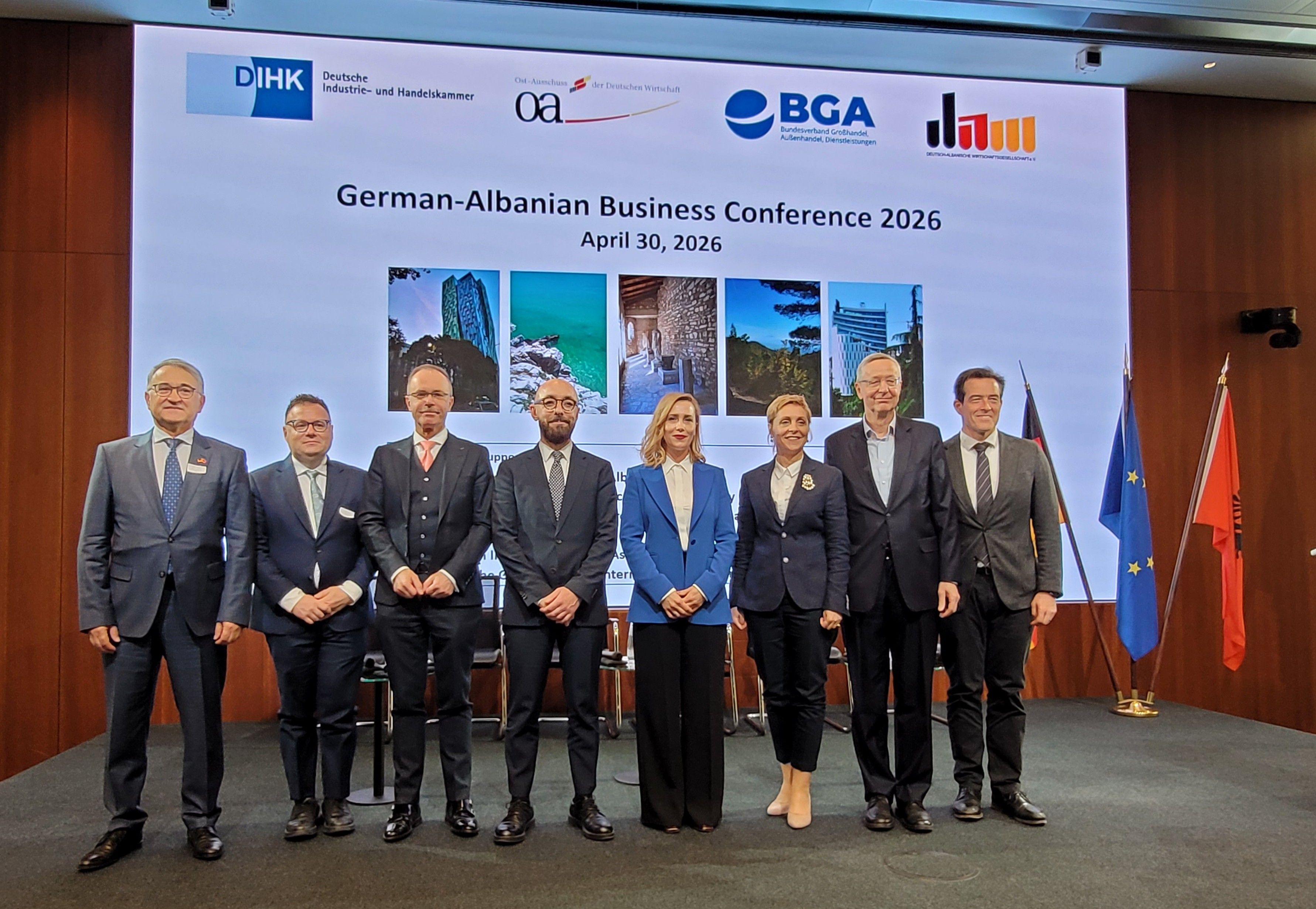
From left to right: DAW President Artan Pojani, Deputy Minister for Agriculture and Rural Development Fatmir Guri, State Secretary at the BMWE Dr. Thomas Steffen, from the Ministry of Economy and Innovation: Deputy Minister Enkelejd Musabelliu and Deputy Minister Dr. Olta Manjani, Ambassador Adia Sakiqi, Managing Director of the Eastern Committee Michael Harms, Member of the DIHK Executive Board and Head of Foreign Trade Dr. Volker Treier
The conclusion of the conference is positive:
Albania offers diverse opportunities for German companies. At the same time, structural reforms — particularly in the areas of legal certainty and anti-corruption — remain crucial for sustainable economic development.